Meet the Author
Rasmus Østergaard is an editor and journalist at Just Add People. Rasmus is responsible for making useful information about the hairdressing trade and the beauty sector easy to access for everyone.
Tips and advice
Lighting – also called hairdresser light – is not a minor item in a hairdressing salon. Read on here to learn all about light for salons
16. May 2025
Light is very complicated. To make it as easy as possible, our recommendation is to shop lighting here, as the models are always up to date. If you need help, you can get it here. If you want to see different hairdresser lighting in real life, you can book yourself in here. If you want to learn a lot, read on below.
The first thing a customer notices – without knowing it – is the light in the room. The colors in the mirror, their own skin tone, the shine in the hair, and the atmosphere in the room are determined by how your lighting distributes lumen, color temperature, and contrast. Yet lighting often ends up as the last thing to be “fixed” – with a quick webshop order of cheap spots from a 100-year-old electrical company offering them at 90% discount. Do yourself a favor: buy professional hairdresser lighting.
Basic lighting corresponds to the canvas you paint on. It must cover the entire floor area without dark zones, so both hairdresser and customer can orient themselves. In practice, this means built-in LED panels or slim track models. The Sun LED panel is a popular choice because it delivers over 90 CRI and a neutral 3,000–3,200 K color temperature, which suits most salons. Find it under the link at the top. Place the panels in a uniform pattern, preferably 120–150 cm apart, depending on the ceiling height. The ceiling height affects how far the light reaches and thus how far apart the panels should be.
Many hairdressers experience that the customer's face suddenly appears “flatter” or the hair color more dull with cheap LED; the cause is almost always low CRI and a bluish spectrum. Choose fewer, but professional lights instead. Directly above each chair — ideally 100–110 cm from the wall and right in the middle of the chair — hangs your most important light source: a linear LED bar with high color rendering, e.g. Sunbeam LED. Here you require CRI > 95, because even the smallest nuances and color differences in ash blonde vs. sand blonde otherwise get lost. The professional lighting should provide 700–1,000 lux at hair working height without glare. Many choose spot lighting for the work area, as the LED is more compact and therefore gives a more precise result than an LED bar. The downside of spots is that if they are not positioned correctly, you can glare the customer or yourself and the chance of harsh – not flattering – shadows is high.
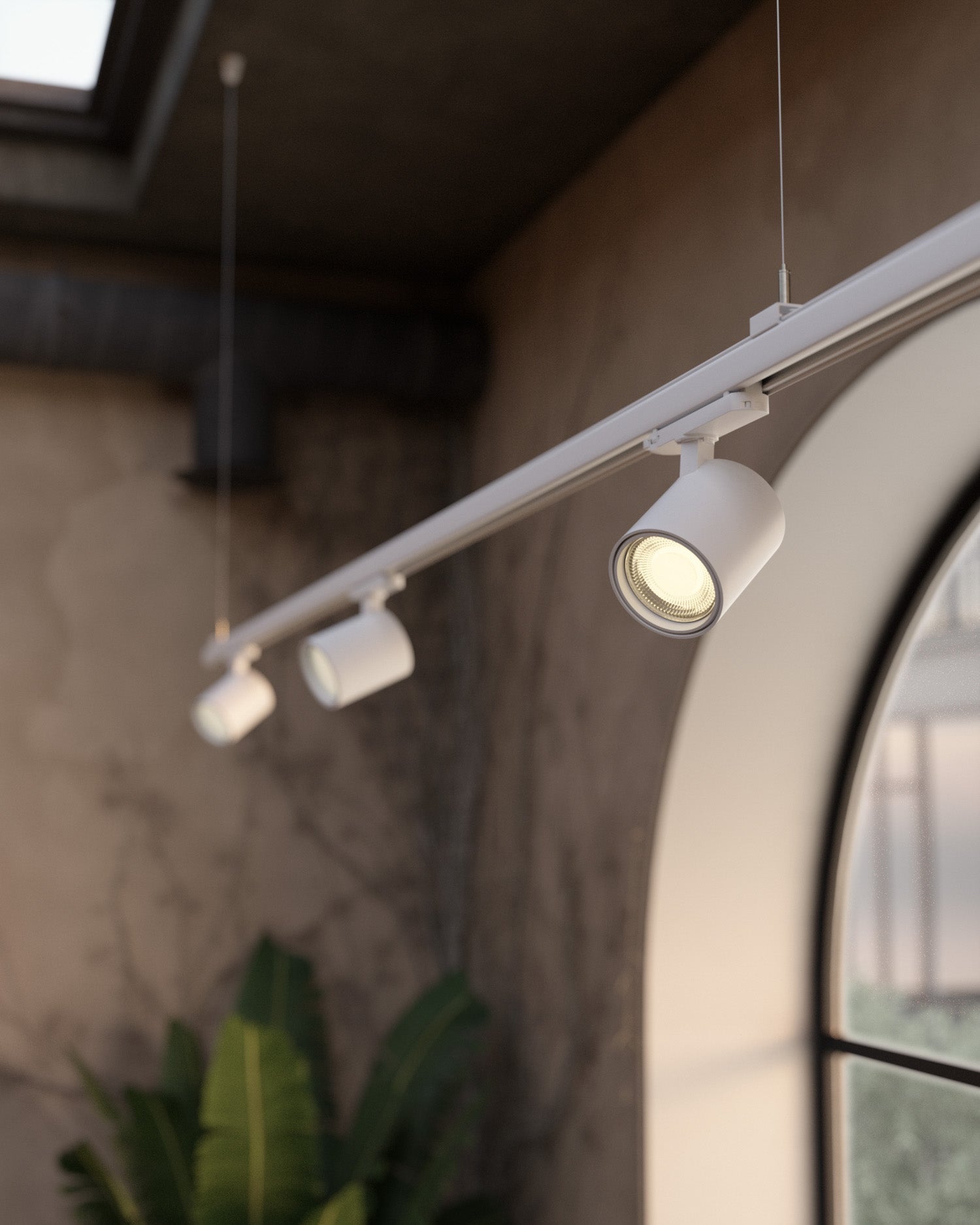
Once the foundation is laid, you create depth with spots on a track, e.g. the Track rail with Sun Spots. Aim the spotlight at product shelves, plants, or art to draw the eye. The main rule is to place the spot as high and far from the object as the ceiling allows, then point the light inward: this minimizes sharp shadows and avoids glaring either the customer or hairdresser. Spots can of course also be used as professional lighting.
Light is also the feeling of well-being. At the reception, in the lounge area, or over the washing station, a decorative pendant can create calm and identity. Remember to choose a dimmable model so the light can be turned down during relaxing scalp massages.
CRI indicates how accurately a light source reproduces colors compared to natural daylight. The scale goes from 0 to 100, where 100 is daylight.
For hair color, we never recommend below 90, and for advanced color work, 95+ is ideal.
3,000–3,200 K is the way forward. If you go down to 2,700 K, the tone becomes very golden; if you go above 4,000 K, the room feels cool and clinical – rarely flattering for the skin.
Halogen and energy-saving bulbs emit about 90% heat and only 10% light. LED uses the opposite logic: 90% of the energy becomes light. This means you can cut your electricity bill by up to 70% by switching fully to LED. The lifespan of 50,000+ hours corresponds to eight years of operation. At the same time, you avoid UV damage to color bottles and product boxes.
LED typically drops 15–20% in lumen over the first 30,000 hours. Do an annual check: Is the basic lighting still bright enough? Do all drivers work? Clean dust on spots and panels; a thin layer of dust can remove up to 10% of the light.
A complete lighting setup for a medium-sized salon can add up – especially if you also need an electrician to install everything. Many choose leasing. The monthly savings on electricity can actually cover much of the payment. At the same time, you get new lamps now, instead of settling for old halogen spots, which also cost you extra on electricity.
Good reading helps, but light must be experienced. In our showroom we have built fourteen separate interiors: from Scandinavian spa to retro barber. Each environment shows exactly how light works together with colors, furniture, and branding.
Please contact us right here to get professional guidance on how to get the most joy from your work when it comes to lighting in your salon.
Rasmus Østergaard is an editor and journalist at Just Add People. Rasmus is responsible for making useful information about the hairdressing trade and the beauty sector easy to access for everyone.